Environmental Management Policy
Etron is committed to sustainable operations and environmental protection, ensuring all products and business activities comply with ESH (Environment, Safety, and Health) and green product regulations, while continuously providing high-performance, energy-saving green products.
Etron has formulated and implemented key environmental policies, such as energy conservation, carbon reduction, water conservation, and waste recycling, and evaluates the risks and opportunities brought by climate change. All environmental policies are signed and supervised by the President, demonstrating the Company’s firm determination to protect the environment and workplace safety.
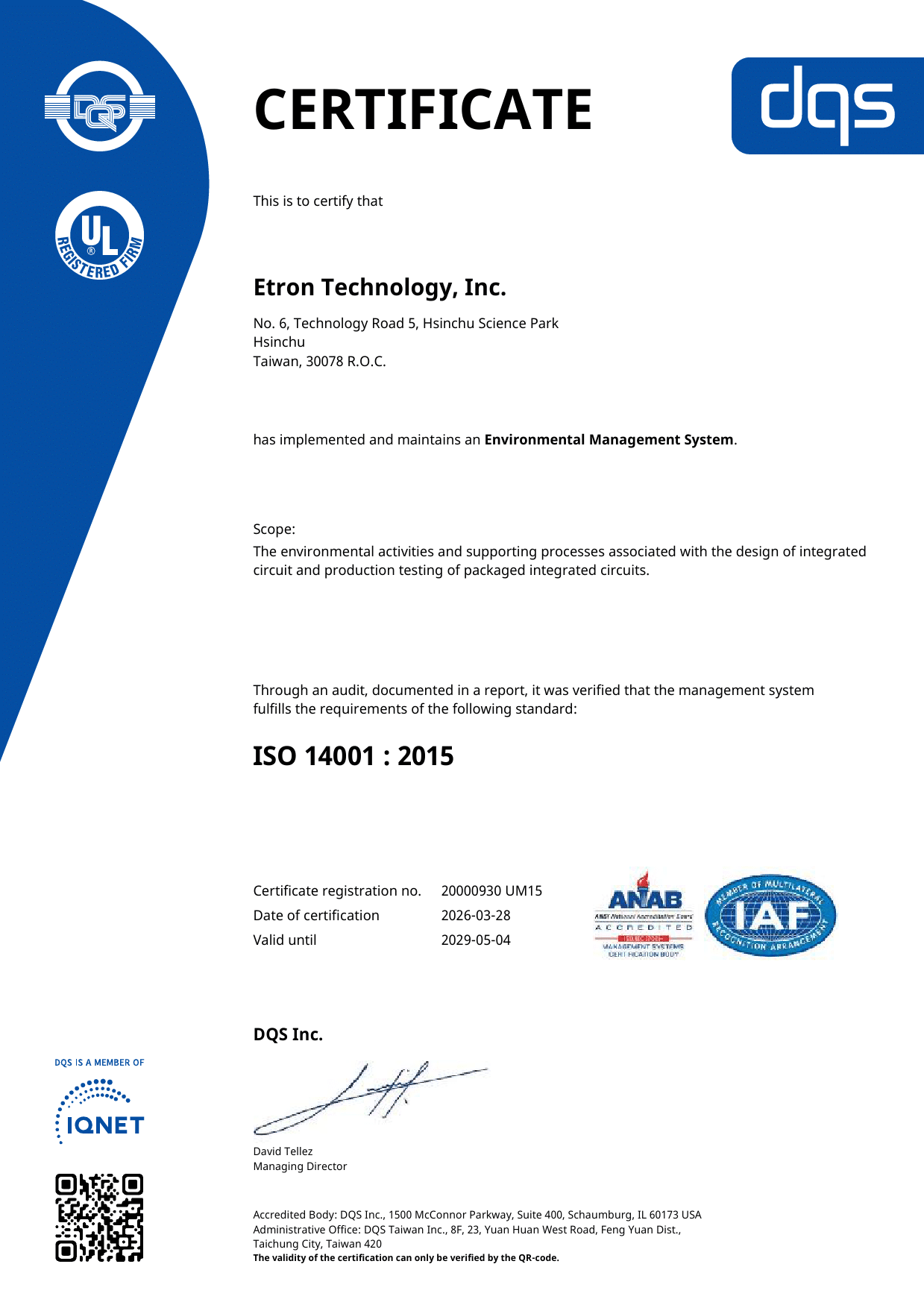
In addition, the Company has obtained and continues to maintain the effective operation of the ISO 14001 Environmental Management System, with regular annual audits. We utilize the PDCA (Plan-Do-Check-Act) cycle mechanism to prioritize the improvement of audit deficiencies, meeting the requirements for continuous improvement of the ESH management system.
ESH Policy
- To comply with government laws and regulations, abide by international environmental safety and health and energy-related trends and green product regulations and other relevant requirements.
- To reduce energy consumption to reduce Greenhouse Gas (GHG) emissions, thereby increasing carbon reserves.
- To encourage the use of environmentally friendly packaging materials and resource recycling to reduce resource consumption.
- To provide a safe and healthy working environment to reduce the risks that personnel are exposed to when performing operations in the workplace.
- To continue to communicate and expand consultation and participation with employees, suppliers and the public, and implement policies on environmental safety, health, energy and green product management.
Water Resources Policy
As an IC design company, Etron does not engage in product production or manufacturing, and thus has no process water requirements. Based on assessment, although the Company’s activities do not cause significant environmental impact on water resources or the ecological environment of water sources, it may still be affected by water shortages caused by extreme climate. Therefore, the Company has established the following water resources management policies:
1. Improve water use efficiency.
2. Assess water resources risks and develop response plans to manage water shortage risks.
Water Resources Management
Etron is located in the Hsinchu Science Park, Taiwan. According to the “Aqueduct Water Risk Atlas” by the World Resources Institute (WRI), the area is not classified as a high water risk area. Based on assessment, operational activities do not cause significant impact on regional water resources or the local ecological environment.
As an IC design company, Etron has no requirements for process water in production or manufacturing. Water is sourced from tap water provided by a third party, and is primarily used for domestic purposes, with the air conditioning system accounting for the largest consumption. To ensure that domestic wastewater discharge meets the water quality standards of the Hsinchu Science Park sewage system, the Company maintains effectiveness by regularly cleaning building sewage treatment facilities and conducts water quality testing twice a year. All test results comply with relevant discharge standards.
Discharge Water Quality Testing
| Inspection Item | SS | BOD | COD |
|---|---|---|---|
| Standard | <300 | <300 | <500 |
| H1 2025 | 89 | 159 | 450 |
| H2 2025 | 92.7 | 168 | 389 |
| H1 2024 | 69.5 | 170 | 316 |
| H2 2024 | 62.5 | 211 | 366 |
| H1 2023 | 108 | 215 | 340 |
| H2 2023 | 111 | 229 | 376 |
Water Consumption
| Year | 2025 | 2024 | 2023 | ||||
|---|---|---|---|---|---|---|---|
| Units (m³) | Million (ML) | Units (m³) | Million (ML) | Units (m³) | Million (ML) | ||
| Water Source | Surface Water | 0 | 0 | 0 | 0 | 0 | 0 |
| Groundwater | 0 | 0 | 0 | 0 | 0 | 0 | |
| Rainwater | 0 | 0 | 0 | 0 | 0 | 0 | |
| Tap Water | 55,810 | 55.81 | 58,884 | 58.88 | 66,811 | 66.81 | |
| Other entities | 0 | 0 | 0 | 0 | 0 | 0 | |
| Total Water Withdrawal | 55,810 | 55.81 | 58,884 | 58.88 | 66,811 | 66.81 | |
| Total Water Discharge | 17,034 | 17.03 | 15,121 | 15.12 | 17,751 | 17.75 | |
| Total Water Consumption | 38,776 | 38.77 | 43,763 | 43.76 | 49,060 | 49.06 | |
Note: As water usage in the Taipei office is limited to restrooms and water dispensers located in public areas with no independent meters or charges, no actual water consumption data is available; therefore, it is not included in this table.
Reduction Actions and Results
Waste Policy
To minimize environmental burden and protect natural resources, Etron has established the following management policies for waste generated from daily operations:
- Comply with national waste management laws and regulations.
- Commit to not using prohibited substances or raw materials in products.
- Actively promote waste reduction, recycling, and reuse.
Waste Management
As an IC design company, the types of waste generated by Etron mainly consist of employees’ domestic waste, general waste, recyclable waste, and a small amount of hazardous business waste from mixed metals (primarily waste ICs and PCBs).
We are committed to reducing environmental impact and practicing resource conservation. We have established management policies for various types of waste generated in daily operations for employees to follow. These include promoting waste sorting and recycling, and installing recycling facilities to improve recycling rates and achieve waste reduction. We also encourage the use of reusable tableware to reduce domestic waste.
| Waste Treatment Volume | ||
|---|---|---|
| Year | Non-hazardous Waste | Hazardous Business Waste |
| 2025 | 84.800 | 0.14 |
| 2024 | 84.684 | 0.31 |
| 2023 | 86.281 | 0.30 |
–
Reduction Actions and Results
Etron continuously promotes waste reduction and waste management through a dual-track approach of source reduction and proper sorting. Regarding general waste, the company implements recycling and reuse mechanisms by strengthening waste sorting awareness and setting up recycling facilities. Concurrently, employees are encouraged to use reusable tableware to minimize the generation of single-use items and domestic waste.
In terms of waste management, the primary source of waste is domestic garbage generated from daily operations, with industrial waste accounting for less than 1% of the total waste volume. The Company manages the entire process in accordance with relevant regulations, sorting, labeling, and safely storing waste based on its characteristics. Subsequently, qualified clearance and disposal organizations approved by competent authorities are commissioned for proper treatment, ensuring that waste management complies with environmental and regulatory requirements.
Etron continuously drives waste reduction and resource management. In 2025, the total volume of waste decreased by approximately 2% compared to 2023, with a long-term goal of achieving a reduction of over 5% by 2030 compared to 2023.
Air Pollution Control Policy
As an IC design company, Etron does not engage in product production or manufacturing; therefore, our operational activities do not involve air pollution activities regulated by national laws. To fulfill our corporate environmental responsibility, the Company has established the following management policies for air pollution prevention:
- Regularly monitor issues and regulations related to air pollution.
- Minimize activities that contribute to air pollution.
- Reduce emissions of air pollutants.